The Theology of A Charlie Brown Christmas
After the first piano notes ring out as snowflakes gently fall on skaters gliding on a frozen pond, we hear these words sung by a children’s choir: “Christmas time is here / Happiness and cheer / Fun for all that children call / Their favorite time of the year.” Charlie Brown’s opening dialogue, however, centers on sadness. Charlie Brown speaks with his friend, Linus, about feeling depressed as Christmas approaches – an experience many can relate to around the holidays. An important truth is captured in the first five minutes of A Charlie Brown Christmas – a truth further underscored by Vince Guaraldi’s superbly melancholic jazz soundtrack: the wood of the manger cannot be separated from the wood of the cross. By his Incarnation, Christ enters a fallen and broken world to save us from our painful state of captivity where we often find ourselves sending up sighs – “mourning and weeping in this valley of tears” – as a beloved Marian prayer puts it.
After the first piano notes ring out as snowflakes gently fall on skaters gliding on a frozen pond, we hear these words sung by a children’s choir: “Christmas time is here / Happiness and cheer / Fun for all that children call / Their favorite time of the year.” Charlie Brown’s opening dialogue, however, centers on sadness. Charlie Brown speaks with his friend, Linus, about feeling depressed as Christmas approaches – an experience many can relate to around the holidays. An important truth is captured in the first five minutes of A Charlie Brown Christmas – a truth further underscored by Vince Guaraldi’s superbly melancholic jazz soundtrack: the wood of the manger cannot be separated from the wood of the cross. By his Incarnation, Christ enters a fallen and broken world to save us from our painful state of captivity where we often find ourselves sending up sighs – “mourning and weeping in this valley of tears” – as a beloved Marian prayer puts it.
The theology of A Charlie Brown Christmas is deceptively deep, as we will explore below. This is, perhaps, an overlooked reason behind the animated special’s remarkable popularity. The TV program drew a viewership of 45 % of the national television audience when it debuted on Dec. 9, 1965, and also won an Emmy Award for Outstanding Children's Program.
And if you want to stump a person with a Yuletide trivia question, try this one… “Name the bestselling jazz album of all time.” It is indeed the soundtrack to A Charlie Brown Christmas by the Vince Guaraldi Trio, an album voted into the Grammy Hall of Fame in 2007. Clearly, Guaraldi was a providential choice to create the music for this Christmas special that brought to life the “Peanuts” comic strip characters created by Charles Schulz, himself a devout Christian and Sunday school teacher.
Overcoming the anti-Gospel of consumerism
When history’s first American Pope was elected, I hoped he would choose the name, Linus II. Pope St. Linus was the first successor of St. Peter, and his pontificate points to the reality that the keys of the kingdom which Jesus gave to Peter would be passed on to his successors until the end of time. (I was also impishly looking forward to cartoonists, with gentle humor, drawing Pope Linus II holding a blanket!) In A Charlie Brown Christmas, it is Linus who helps Charlie (and all of us) understand that acquiring things – even Christmas presents – can never truly fulfill us. Pope Leo XIV recently echoed Linus’ insight in his own words: “While the consumer culture influences our tastes, constantly creating new needs only to sell us solutions that never satisfy, and that sometimes even poison the heart, we must learn to grasp what truly matters: the treasure of a relationship with God that opens us to joy and helps us to live our relationships with one another more fully.” Communio, not consumerism, is our true vocation.
Sharing the Good News
In the most crucial scene, Charlie Brown cries out in a loud voice, “Isn’t there anyone who can tell me what Christmas is all about?” Linus responds by going to the center of the stage. He then recites the King James Version of Luke 2:8-14, which includes these lines: “And the angel said unto them, Fear not: for, behold, I bring you good tidings of great joy, which shall be to all people. For unto you is born this day in the city of David a Saviour, which is Christ the Lord.” Here, Linus uses Scripture to share the kerygma – a Greek word that means the core message of Christianity – in this case, that the eternal Son of God became man to save us. Joyfully sharing the kerygma with others is precisely what the Church is asking all Christians to do with fresh, Spirit-inspired enthusiasm. Linus models the kind of humble, holy boldness we need to share the Good News in an increasingly post-Christian culture.
Linus and Jesus
The most famous tune from Vince Guaraldi’s soundtrack is “Linus and Lucy,” which the characters dance to in a particularly endearing scene. However, the “Linus and Jesus” connections are what truly stand out. Linus accompanies his depressed and bullied friend, Charlie, in a very Christ-like way. In recent years, the Church has been pleading with Christians to accompany those in need…to lovingly walk with them in the same way the risen Lord Jesus walked with the two dejected disciples on the road to Emmaus. (Lk 24:13-35) Pope Francis said that the Church (which means us!) needs to be like a field hospital, accompanying and ministering to the wounded, broken people around us. Linus embodies this ideal by the way he supports his hurting friend rather than mocking and condemning him as the other children do.
The Tree and “the Little Way”
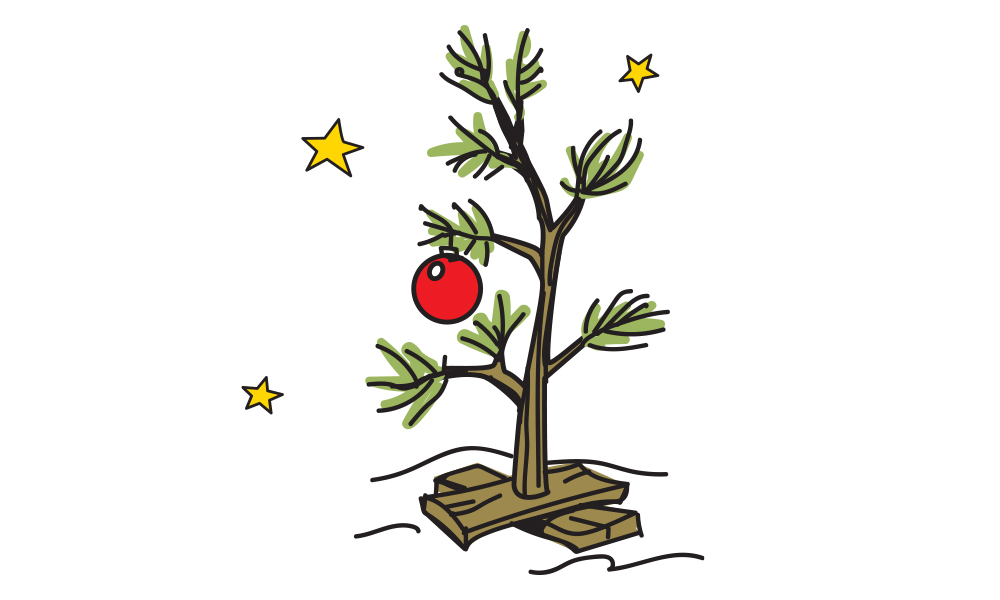
Not surprisingly, it is Linus who walks with Charlie on his ill-fated mission to pick out a tree for the Christmas play he is directing. Charlie famously picks out a tiny little pine tree that could have been easily overlooked amidst a field of glitzy, metallic trees. He then gets ruthlessly mocked for the littleness of the tree he has chosen. Trees, of course, have tremendous significance throughout Sacred Scripture. In the first book of the bible, we read about “the tree of life in the middle of the garden and the tree of the knowledge of good and evil.” (Gen 2:9) The tree of life reappears in the vision of heaven contained in the bible’s final chapter: “Then the angel showed me the river of life-giving water, sparkling like crystal, flowing from the throne of God and of the Lamb down the middle of its street. On either side of the river grew the tree of life….” (Rev 22:1-2) But the most meaningful tree for Christians is the “tree” of the cross upon which Jesus laid down his life to save us. Every Christmas tree hints at this other “tree” where Jesus fulfills his mission of coming to earth to save us. The name, Jesus, literally means “he who saves.”
It is striking that, having just heard Linus read the scriptural account of the birth of Jesus, Charlie is intuitively drawn to choose a humble, little tree. This makes tremendous theological sense. The eternal Son, who with the Father and the Holy Spirit is fully Almighty God, chooses to come to our world as a seemingly helpless tiny baby. In the Lord’s eyes, humility is powerful! “Amen, I say to you, unless you turn and become like children, you will not enter the kingdom of heaven. Whoever humbles himself like this child is the greatest in the kingdom of heaven.” (Mt 18:3-4)
The Christmas tree chosen by Charlie Brown thus points to this paradoxical divine truth about littleness. It also calls to mind the wisdom of the great saint and Doctor of the Church whose religious name reflects her spirituality, St. Therese of the Child Jesus. Since her death in 1897, numerous popes have said that her spiritual path to holiness – her “Little Way” – is the most important one for lay people to follow. She taught that if we are child-like and do the little things in life with great love for God, we can become great saints. Even picking up a fallen pine is sanctifying if done out of love for God.
Restoration and Communion
After Charlie Brown is ridiculed by other children for his choice of a tiny tree, he returns home still hopeful that his tree can work for the school play. But he descends into an even deeper sadness when he believes he has killed the little tree, which bends over from the weight of a single ornament. Then, when things look bleak, everything changes – just like everything changed when God became man to restore the human race which was dead to sin. The other children follow Charlie and somehow restore the damaged tree, which suddenly looks magnificent. When Charlie beholds the beauty of the restored tree, he is overcome and silent. Then the children proclaim, “Merry Christmas, Charlie Brown!” before singing “Hark! the Herald Angels Sing.” Charlie joins them in singing this beloved carol.
Packed into this closing sequence are two themes that lie at the heart of Christianity: restoration and communion. St. Athanasius once compared the mission of Christ coming to earth to an art restoration project. The little tree being restored points to the truth that Jesus came to restore the beauty of human beings after we had been deformed by sin. As usual, in a Christ-like way, it is Linus who begins restoring the damaged tree, saying, “I never thought it was such a bad little tree.” After wrapping his blanket around the trunk, he then says, “Maybe it just needs a little love.” God is love, and it is by experiencing his infinite, personal love and forgiveness that each of us can find healing and restoration in our own lives.
Finally, the scene of the community of children signing together in harmony is a touching icon of the communion God calls us to – not just in heaven but in this life, too. Called to Communion is the title of Pope Benedict XVI’s book on the Church, which is fitting since Jesus founded the Church to be the place where we experience the most profound communion with the Lord this side of heaven (and as a fruit of this, true communion with one another). To be in communion also means to be reconciled, a key theme reflected in the classic carol which the “Peanuts” children triumphantly proclaim as the final credits roll: “Hark! the herald angels sing, / ‘Glory to the newborn King: / peace on earth, and mercy mild, / God and sinners reconciled!’”
Dr. Dan Osborn is the Diocesan Theologian and Coordinator of Permanent Diaconate Formation & Ministry for the Diocese of Saginaw.