In Thanksgiving for the Catholic Spirit of Both/And
One of the joys of serving as the Bishop’s Delegate in Ecumenical and Inter-Faith Relations is that I not only spend time in prayer with non-Catholic pastors in our diocese, but I also get to visit with them over coffee or lunch. I am increasingly convinced that many of our protestant brothers and sisters can enrich us Catholics, especially with their culture of evangelization and their gift for mentoring missionary disciples.
One of the joys of serving as the Bishop’s Delegate in Ecumenical and Inter-Faith Relations is that I not only spend time in prayer with non-Catholic pastors in our diocese, but I also get to visit with them over coffee or lunch. I am increasingly convinced that many of our protestant brothers and sisters can enrich us Catholics, especially with their culture of evangelization and their gift for mentoring missionary disciples.
At the same time, I find myself greatly desiring that they could enjoy the gifts we have as Catholic Christians, especially the Eucharist, the sacrament of Reconciliation, and devotion to our heavenly intercessors, Mother Mary and the saints … just to name a few. But there is one other gift Catholics are blessed with for which I find myself more and more grateful. It is part of the title of a book on my “to read” list, Bishop Robert Barron’s Vibrant Paradoxes: The Both/And of Catholicism. The spirit of “both/and” is like a golden thread woven throughout the tapestry of our Catholic faith. In many essential areas, protestant denominations and the Orthodox Church are 100 percent in agreement with the both/and approach maintained by the Catholic Faith, such as in these two examples:
What is Jesus? True God and true man. Jesus has both an eternal divine nature and the human nature he took to himself when he was made incarnate in the womb of Mother Mary. However, it is crucially important to clarify that he is only one divine person – the eternal Son of God. There is no human person in Christ. “Person,” of course, simply answers the question, “who are you?” And it is precisely because Mary gave birth to a divine person (not a human person) that the Church teaches that she is the Mother of God.
What is Mary? All Christians who take the bible seriously have the same answer: Mary is both virgin and mother – although a number of protestant believers do not accept the Catholic (and Orthodox) teaching that Mary is “ever-virgin.” They cite New Testament passages that refer to the “brothers” of Jesus, not realizing that this was a term used in the time of Christ to simply mean cousins. It is a wonderful blessing that Mary is both Virgin and Mother. She is thereby a model for both the married and celibate vocations. All women of faith who have physically given birth can feel close to her and rely on her prayerful accompaniment, as can all spiritual mothers (not only religious sisters who take a vow of celibacy, but all Christian women who, for whatever reason, do not have children, whether married or not); they all can imitate Mary by maternally forming others in faith. Despite areas of agreement, there are questions which non-Catholics often look at as “either/or” questions instead of “both/and”…
What is the foundation of the Church founded by Jesus Christ?
Many of our protestant brothers and sisters would tend to answer this question by emphasizing Peter’s confession of faith, captured in Matthew’s gospel when Jesus said to the apostles, “‘But who do you say that I am?’ Simon Peter said in reply, ‘You are the Messiah, the Son of the living God.’ Jesus said to him in reply, ‘Blessed are you, Simon son of Jonah. For flesh and blood has not revealed this to you, but my heavenly Father. And so I say to you, you are Peter, and upon this rock I will build my church, and the gates of the netherworld shall not prevail against it. I will give you the keys to the kingdom of heaven. Whatever you bind on earth shall be bound in heaven; and whatever you loose on earth shall be loosed in heaven.” (Mt 16:15-19) It should not be surprising that the Catechism of the Catholic Church actually gives a both/and response: Jesus founds his one Church both on Peter (kepha in Aramaic) and on his confession of faith. (See CCC 424 and especially CCC 552.) Of course, a key mark of Catholicism is that we hold that the keys given by Christ to St. Peter giving him authority to govern the Church have been passed on to his successors for almost 2000 years, down to Pope Leo XIV in our own day.
What is “Divine Revelation” for Christians? Martin Luther famously answered this questions with two Latin words: sola scriptura (meaning “scripture alone”). By contrast, the Catholic Church has from the beginning recognized that while Sacred Scripture is the inspired Word of God, so are the words and deeds of Christ that were not written down but which have been transmitted by the Church throughout her history. The Church calls this other font of divine revelation “Sacred Tradition.” And the historical reality is that the apostles’ oral preaching of what God had revealed in Christ actually predates the written New Testament.
Are Christians justified by faith or works? Luther’s answer to this question was also summarized by two Latin words: sola fide (“faith alone”). The Catholic Church looks to James 2:14-17 for the “both/and” answer to this question: “What good is it, my brothers, if someone says he has faith but does not have works? Can that faith save him? If a brother or sister has nothing to wear and has no food for the day, and one of you says to them, ‘Go in peace, keep warm, and eat well,’ but you do not give them the necessities of the body, what good is it? So also faith of itself, if it does not have works, is dead.” Catholic teaching insists that we are justified by faith, but this faith needs to blossom, by the grace of God, into concrete works of Christian love.
What is the Holy Eucharist? The Eucharist is both the substance of the Risen Christ himself and the richly symbolic forms of bread and wine that we taste and see and feel when we receive Holy Communion. (Catholic teaching calls these “the accidents” of the Eucharist, while insisting that “the substance” is truly the Lord Jesus.) St. Paul taught about both realities. He both insisted on the real presence of Jesus: “The cup of blessing which we bless, is it not a participation in the blood of Christ? The bread which we break, is it not a participation in the body of Christ?” (1 Corinthians 10:16); and he also saw in the form of the one loaf a profound symbol of the unity that Christ and his Church call us to: “one bread, one body,” – the title of the popular hymn which paraphrases Paul’s teaching.
Is the Eucharist a noun or a verb? I was told that, some years ago, a bishop visiting a parish was caught by surprise when someone asked him: “Do you believe the Eucharist is a noun or a verb?” Apparently, the bishop had never heard this question before. The Catholic view, of course, is predictably “both/and.” As Vatican II teaches:
“Taking part (verb) in the Eucharistic sacrifice (noun), which is the fount (noun) and apex (noun) of the whole Christian life, they offer (verb) the Divine Victim (noun) to God, and offer themselves along with It. Thus, both by reason of the offering (noun) and through Holy Communion (noun) all take part in this liturgical service (noun), not indeed, all in the same way but each in that way which is proper to himself. Strengthened in Holy Communion (noun) by the Body of Christ (noun), they then manifest in a concrete way that unity of the people of God which is suitably signified and wondrously brought about by this most august sacrament (noun).” (Lumen Gentium, 11)
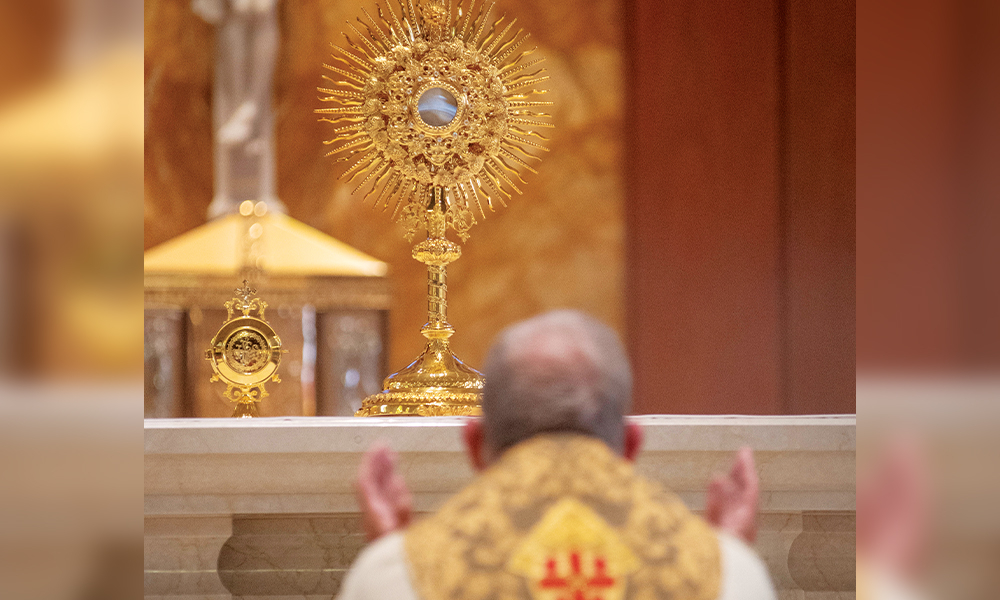
I do not know for sure, but perhaps what lay behind this question to the bishop was someone’s desire to emphasize a point the Church fully agrees with. Namely, that actively “taking part in” what Vatican II terms “the Eucharistic Sacrifice” (the Mass) is of supreme importance. It is the Mass that the Fathers of the Second Vatican Council remind us is the source and summit of our Christian lives. In previous decades, however, some influential theologians unfortunately promoted the idea that adoration of the Blessed Sacrament outside of Mass is somehow in competition with the celebration of Mass; one even categorized Eucharistic Adoration outside of Mass as a devotion for the less intelligent members of the Church. It was a young Fr. Robert Barron who responded to this assertion with a list of intellectual giants for whom adoration of the Eucharist outside of Mass was a key part of their spirituality, from St. Thomas Aquinas to St. Edith Stein to Pope St. John Paul II. And it was this saintly pope’s successor, Pope Benedict XVI, who articulated the balanced, “both/and” Catholic view when he explained that while the celebration of Mass is primary, Mass should lead us to adore Jesus in the Blessed Sacrament outside of Mass which should then in turn lead us back to “the source and summit,” Holy Mass.
Embracing the “both/and” in this case is quite an urgent matter, given recent surveys on how men are discerning and following a priestly vocation. For instance, the 2025 “Survey of Ordinands to the Priesthood” by CARA found that 78% of the respondents had participated in regular Eucharistic adoration before entering seminary, with 89% receiving words of encouragement to consider the priesthood by someone in their life. So, as we pray fervently for more priests and personally ask men to consider this special vocation, a warm invitation for them to take part in both the Mass and Eucharistic Adoration outside of Mass will bear much fruit.
Dr. Dan Osborn is the Diocesan Theologian and Coordinator of Permanent Diaconate Formation & Ministry for the Diocese of Saginaw.