The Mystery of Suffering and Calvary’s Superabundance of Love
This past Christmas, the news of two well-known Catholic families in anguish led to a global response of prayers for healing. On Dec. 21, 2025, the youth and young adult speaker Paul J. Kim announced that his 5-year-old son, Micah, was in a health crisis after contracting a severe case of influenza. Sadly, Micah died on Dec. 31.
This past Christmas, the news of two well-known Catholic families in anguish led to a global response of prayers for healing. On Dec. 21, 2025, the youth and young adult speaker Paul J. Kim announced that his 5-year-old son, Micah, was in a health crisis after contracting a severe case of influenza. Sadly, Micah died on Dec. 31.
On that same Christmas Eve, two other Catholic youth speakers, Jason and Crystalina Evert, asked for urgent prayers for their son, John Paul, who had just been diagnosed with Stage 2 Hodgkin's Lymphoma. They were told their son needed to start cancer treatment immediately. Some Franciscan Friars of the Holy Spirit came and prayed by their son’s bedside, even asking God to liquefy the cancer.
And here is where the mystery of suffering and the beauty of the communion among the members of the Body of Christ (the Church) intersect in a profound way. In their anguish, the Everts received a message from Paul J. Kim and his wife, who said they were offering their suffering with Micah as a prayer for John Paul's healing. On New Year’s Day, when Kim announced his son’s passing, he said he believed, “God is using the life of my 5-year-old to truly save souls and change the world.”
A few days later, when John Paul’s doctors performed surgery, they did not find a malignant tumor on his neck which they were almost certain they would discover. Instead, they were surprised to find an orange-sized mass that was more liquid than solid. After further tests, the doctors declared John Paul to be free of cancer.
Life’s greatest mystery and God’s “answer”
Most children would quickly ask the key question about what happened with the Kim and the Evert families. “Dad, Mom ... if God is all-loving, why did he answer the prayers for John Paul but not for Micah?” This side of heaven, we do not have any easy answer to the mystery of why some prayers for healing get answered, and others do not – or more to the point, why God permits so much suffering in our earthly life, which a beloved Marian prayer calls “this valley of tears.”
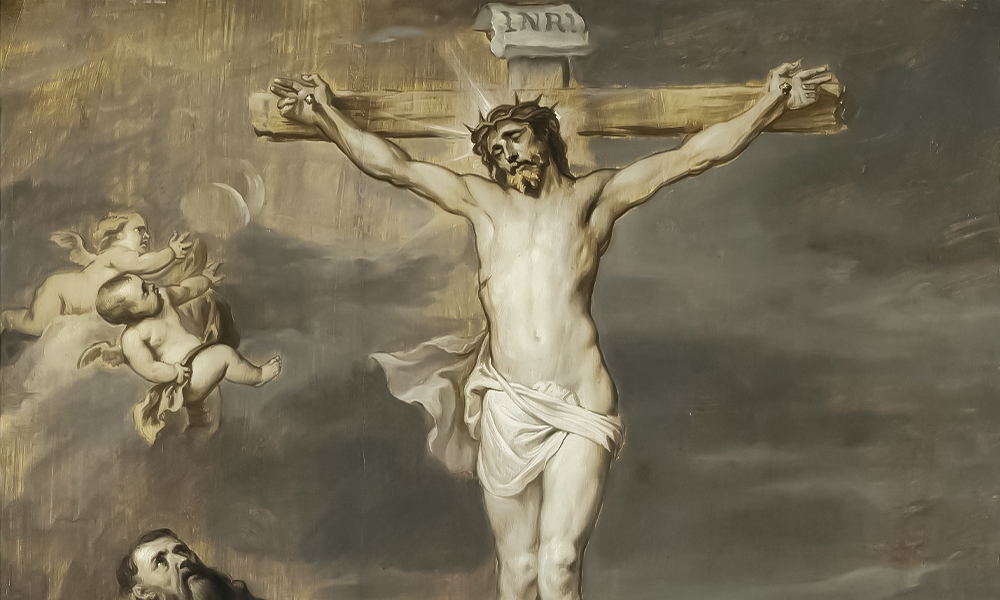
During Lent, and especially on Good Friday, we are invited to contemplate God’s only “answer” to the mystery of suffering: Christ crucified. In his marvelous book, Making Sense Out of Suffering, Peter Kreeft comments on “the mystery, not just of suffering but of suffering in a world supposedly created by a loving God”:
How to get God off the hook? God's answer is Jesus. Jesus is not God off the hook but God on the hook. That's why the doctrine of the divinity of Christ is crucial: If that is not God there on the cross but only a good man, then God is not on the hook, on the cross, in our suffering. And if God is not on the hook, then God is not off the hook. How could he sit there in heaven and ignore our tears? There is, as we saw, one good reason for not believing in God: evil. And God himself has answered this objection not in words but in deeds and in tears. Jesus is the tears of God.
As Kreeft points out, Jesus not only suffers for us, he suffers with us – in solidarity with all of the painful things we experience in life. This, I suppose, is why up until modern times, Catholic hospitals would always have a crucifix hanging in patients’ rooms. Christ crucified is the only “answer” to the mystery of suffering, and to all the personal suffering that you and I experience.
Why did Jesus suffer so much to redeem us?
The actor Kevin James has shared that his life changed dramatically when, encouraged by his dad, he decided to watch The Passion of the Christ in a movie theater on Good Friday, 2005. Seeing the cinematic depiction of the amount of blood that Jesus shed to save the human race inspired James to return to the practice of the Catholic faith that he had been raised in.
During a TV interview, James explained: “My father was a very devout Catholic, and I grew up Catholic and going to church all the time and grew up and had faith in God. But I never really connected enough. I remember him telling me [on that Good Friday] ... ‘Remember, this is the day our Lord died.’”
His father passed away the following year, consoled to know that his son was now a practicing Catholic once more. The power of the Cross had done its work.
When we ourselves gaze at Jesus hanging in agony on the Cross, we are faced with yet another mystery – and another question. Why did Jesus have to shed so much blood and face such extreme torture to save us? The reality is that he did not “have to” at all. Jesus is the second Person of the Holy Trinity – he is, together with the Father and the Holy Spirit, God. And God could have saved us from the evil one and from sin and death without the shedding of even a drop of blood. As St. Thomas Aquinas states in his Summa Theologiae, “Therefore, speaking simply and absolutely, it was possible for God to deliver mankind otherwise than by the Passion of Christ, because ‘no word shall be impossible with God’” (Lk 1:37).
So why did God choose to save us through Christ’s extreme bloody sacrifice on Calvary? The most profound answer is also the simplest: the extremity of God’s personal love for each of us. Bishop Robert Gruss’ episcopal motto, “No greater love,” captures the key relevant teaching of Jesus at the Last Supper: “There is no greater love than to lay down one's life for one's friends.” (Jn 15:13) Aquinas prioritizes divine love as the reason Jesus bore such pain in his saving Passion: “... Many other things besides deliverance from sin concurred for man's salvation. In the first place, man knows thereby how much God loves him, and is thereby stirred to love Him in return, and herein lies the perfection of human salvation.” The superabundance of God’s love evident in Christ’s Passion and sacrificial death on Calvary is therefore meant to call us to love the Lord in return – to open our own arms wide in loving surrender to the one who loves his disciples “to the end” (Jn 13:1), even to the extremes of suffering that he endured on the cross for our salvation: “Jesus knew that his hour had come to pass from this world to the Father. He loved his own in the world and he loved them to the end.”
And once we have responded in loving surrender to the superabundance of divine love on display at Calvary, we are then called to share with others the Good News of God’s saving love for us in Christ. “The Church exists to evangelize,” said Pope St. Paul VI. Each of us, called to evangelization with our prayers and words and deeds and witness, would do well to follow the golden, humble advice of St. Paul who, like his Savior, also suffered imprisonment and death after his life- changing encounter with Christ on the road to Damascus:
When I came to you, brothers, proclaiming the mystery of God, I did not come with sublimity of words or of wisdom. For I resolved to know nothing while I was with you except Jesus Christ, and him crucified. I came to you in weakness and fear and much trembling, and my message and my proclamation were not with persuasive (words of) wisdom, but with a demonstration of spirit and power, so that your faith might rest not on human wisdom but on the power of God. (1 Cor 2:1-5)
Like Paul, our loving response to God’s over-the-top love shown forth on Calvary is to “proclaim Christ crucified.” (1 Cor 1:23)
Dr. Dan Osborn is the Diocesan Theologian and Coordinator of Permanent Diaconate Formation & Ministry for the Diocese of Saginaw.