A Winter’s Tale of Wisdom from the Womb
Curling up near a fireplace… a cup of hot cocoa in your hands… as you watch, through frosted windows, the spectacle of wind-blown snow. This is likely the most womb-like experience we have as we grow older. While Gordon Lightfoot is well known for his wistful account of “The Wreck of the Edmund Fitzgerald,” another of his ballads, sometimes overlooked, is marvelous to listen to the next time you are enjoying the comfort of your home on a frigid evening. His opening lines in “Song for a Winter’s Night” artfully capture the mood of being in a warm womb-like room, protected from the outside chill:
The lamp is burnin’ low upon my tabletop / The snow is softly falling
The air is still in the silence of my room / I hear your voice softly calling
Curling up near a fireplace… a cup of hot cocoa in your hands… as you watch, through frosted windows, the spectacle of wind-blown snow. This is likely the most womb-like experience we have as we grow older. While Gordon Lightfoot is well known for his wistful account of “The Wreck of the Edmund Fitzgerald,” another of his ballads, sometimes overlooked, is marvelous to listen to the next time you are enjoying the comfort of your home on a frigid evening. His opening lines in “Song for a Winter’s Night” artfully capture the mood of being in a warm womb-like room, protected from the outside chill:
The lamp is burnin’ low upon my tabletop / The snow is softly falling
The air is still in the silence of my room / I hear your voice softly calling
From December to March, it is striking how much the Catholic liturgical calendar draws our attention to the holiest place on earth (other than the tabernacle and altar in a church): the human womb. Let’s take a look at how some wintertime Catholic feast days whisper, as it were, valuable wisdom from the womb.
Dec. 8: Solemnity of the Immaculate Conception of the Blessed Virgin Mary
In the womb of St. Anne, Mary is conceived without original sin, an event that marks the beginning of the end of the devil’s pitiless reign over the human race. Although he was not Catholic, the English poet William Wordsworth once called Mary “Our tainted nature’s solitary boast.” She is indeed the one human person in history that the devil never got a hold of through sin, a reality that drives the fallen angel mad. This is why the enemy of God must have a particular loathing of this feast day. However, as captives set free by Christ, the son of Mary, we have great cause to rejoice every Dec. 8, which (usually) is a holy day of obligation in the United States. Mary is the patroness of the U.S. under this unique title.
In a recent interview, Father Francesco Bamonte, president of the International Association of Exorcists, explains how the devil reacts to the sinless Virgin Mary during the Rite of Exorcism. “When we see the devil raging because Our Lady is invoked, it is because he feels the presence of Our Lady. I am often struck by the experience I have when, during the exorcism, the devil complains that there is too much light. When I order him to tell me where that light comes from, he says, ‘It comes from her.’ Somehow, he is angry precisely because he notices that Our Lady is praying, and she is close to that son who is suffering, to that daughter who is suffering. For us exorcists, this is a great consolation because we see how truly Our Lady is a mother during this ministry.”
So, the next time we are tempted, let’s remember the power of asking the sinless Mother to pray for us. It might be a simple Hail Mary or perhaps this brief prayer given to St. Catherine Labouré by Mary herself during her 1830 Miraculous Medal apparitions in Paris: “O Mary, conceived without sin, pray for us who have recourse to thee.”
Dec. 12: Feast of Our Lady of Guadalupe
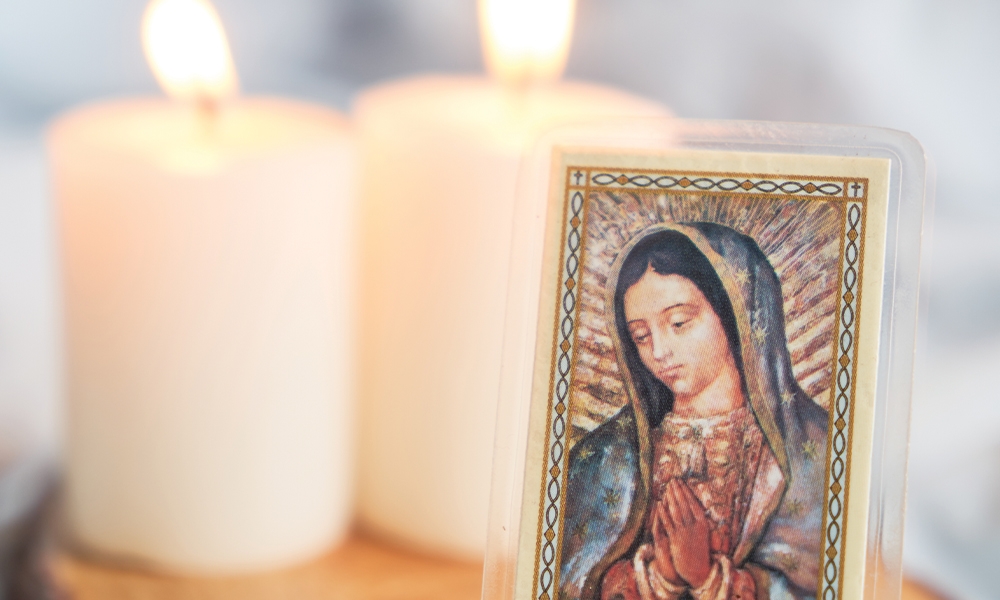
The womb of Mary is emphasized in a fascinating way in the image of Our Lady of Guadalupe, which miraculously appeared on the tilma (a cactus fiber tunic) of St. Juan Diego in Mexico on Dec. 12, 1531. The apparitions of Mary to this simple peasant and the heaven-made image on his garment, which scientists are still at a loss to explain, led to the conversion of millions of people to the Catholic faith throughout the Americas.
As David Clayton observes in his article on the image, “Our Lady’s hairstyle, with the central parting, was in 16th-century Aztec culture the sign of a maiden, a virgin. The ribbon and bow around her waist signified that she was pregnant. So this is a young woman who is portrayed simultaneously a virgin and pregnant.” To an Aztec society that so embraced what St. John Paul II termed “the culture of death” — even to the point of accepting human sacrifice with Aztec “priests” extracting beating hearts — the symbolism in the image of Our Lady of Gaudalupe proclaimed the gospel of life. It is no wonder that Our Lady of Guadalupe is looked upon not only as the patroness of the Americas but also as a special saint for the pro-life movement in its efforts to stop preborn children from being aborted.
Guadalupe is just one example of how, in the face of evil, there stands not only Christ but also his holy Mother. If you wish to contemplate this reality, spend some time gazing at the image of Our Lady of Guadalupe while prayerfully reading these lines from Scripture, which portray the enmity between the dragon and the Woman who is truly the new ark, not only of the New Covenant but of God himself:
Then God’s temple in heaven was opened, and the ark of his covenant could be seen in the temple…. A great sign appeared in the sky, a woman clothed with the sun, with the moon under her feet, and on her head a crown of twelve stars. She was with child and wailed aloud in pain as she labored to give birth. Then another sign appeared in the sky; it was a huge red dragon… Then the dragon stood before the woman about to give birth, to devour her child when she gave birth. (Rev. 11:19; 12:1-4)
Dec. 25: The Nativity of the Lord (Christmas)
Redeemer in the Womb: Jesus Living in Mary is a splendid meditation on Christ in utero by John Saward. Jesus in the womb of his mother is at every moment the second person of the Holy Trinity, and perhaps we in the west would do well to contemplate this mystery more deeply. Our eastern Christian brothers and sisters, though — both Byzantine Catholic and Orthodox — pray a lengthy liturgical poem to Mary called the “The Akathist Hymn” in which they refer to her as the “container of the Uncontained God.” At Christmas, the Gospel readings at the Vigil Mass and the “Mass during the Night” both present us with the figure of Mary, who contains in her womb the uncontained and infinite Son of God. Mary is truly Mother of God from the moment the Lord is conceived in her womb through the power of the Holy Spirit, long before she gives birth to him in Bethlehem.
Jan. 1: Solemnity of Mary, the Holy Mother of God
How fitting it is that we begin the New Year turning our eyes to the Mother of God, since it was in her womb that a New Era began — the era of Christ the King who, through his death, rescues us from death and sin. It was at the third Ecumenical Council in Ephesus in 431 that the Church formally proclaimed the dogma that Mary is the Mother of God. The people of Ephesus rejoiced, and it was providential that this of all ancient cities was the site where this most important of all Marian doctrines was defined. The first bishop of Ephesus was John, to whom Jesus entrusted his mother at the cross (though some modern scholars debate whether John and the Beloved Disciple are the same person). There is even a pious tradition that Mary had a little home in Ephesus after John took her into his care in obedience to Christ.
Of course, more than four centuries before the Council of Ephesus, St. Elizabeth first uttered this Marian title when she was visited by her young pregnant cousin. Inspired by the Holy Spirit, Elizabeth exclaimed: “And how does this happen to me, that the mother of my Lord should come to me? (Lk. 1:43) Keep in mind that Jewish people did not say the holy name of God — they said “Lord” instead (in Hebrew, Adonai; in Greek, Kurios or Kyrios). So, Elizabeth was actually calling Mary “the Mother of God.”
Before the matter was settled in Ephesus, some had argued that this title was too exalted for Mary. They claimed that she gave birth only to the human nature of Jesus. But the Council fathers, led by the Spirit, also used common sense in their response. “A mother does not give birth to a nature; she gives birth to a person,” they clarified. In Mary’s case, the person she gives birth to is the Second Person of the Holy Trinity — the eternal Son who is God. Therefore, she is rightly called the Mother of God.
March 25: Solemnity of the Annunciation of the Lord
Winter officially ends a few days before the Annunciation of the Lord on March 25, when the Church celebrates the moment when the Eternal Son of God took on a human soul and a human body in the womb of Mary. All of human history revolves around this moment of the Incarnation, when God entered time to rescue us. Indeed, a new springtime of hope and life and joy and love and salvation begins when, in Mother Mary’s womb, “the Word became flesh and made his dwelling among us, and we saw his glory, the glory as of the Father’s only Son, full of grace and truth.” (Jn. 1:14)
Dr. Dan Osborn is the Diocesan Theologian and Coordinator of Permanent Diaconate Formation & Ministry for the Diocese of Saginaw.