War took their home. Faith carried them forward.
Ukrainian family recounts their journey as refugees— and their faith in God’s providence that has kept them going
Ukrainian family recounts their journey as refugees— and their faith in God’s providence that has kept them going
In November the United States Conference of Catholic Bishops (USCCB) released a Special Message at their recent plenary assembly (see page 4) regarding immigration in the U.S., in which they defend the God-given human dignity of all persons, including immigrants.
“The priority of the Lord, as the Prophets remind us, is for those who are most vulnerable: the widow, the orphan, the poor and the stranger (Zec. 7:10),” the message reads.
Editor’s note: Some quotes have been slightly edited for clarity.
“Honey, wake up. We have war.”
Oksana Chornyy (in English, Black) remembers her husband Yuriy waking her up at 5 a.m. with a kiss on her head. Just the night before, they had been celebrating the birthday of their friend’s daughter. There was chatter that something bad might happen in Ukraine, but they didn't believe it.
“It's impossible, because the world will judge if it happens, you know,” Oksana recalled thinking.
On Feb. 24, 2022, that changed when Russia launched a full-scale invasion.
In November the United States Conference of Catholic Bishops (USCCB) released a Special Message at their recent plenary assembly (see page 4) regarding immigration in the U.S., in which they defend the God-given human dignity of all persons, including immigrants.
“The priority of the Lord, as the Prophets remind us, is for those who are most vulnerable: the widow, the orphan, the poor and the stranger (Zec. 7:10),” the message reads.
Editor’s note: Some quotes have been slightly edited for clarity.
“Honey, wake up. We have war.”
Oksana Chornyy (in English, Black) remembers her husband Yuriy waking her up at 5 a.m. with a kiss on her head. Just the night before, they had been celebrating the birthday of their friend’s daughter. There was chatter that something bad might happen in Ukraine, but they didn't believe it.
“It's impossible, because the world will judge if it happens, you know,” Oksana recalled thinking.
On Feb. 24, 2022, that changed when Russia launched a full-scale invasion.
"We had dreams”
In their hometown in western Ukraine, the Chornyy family was “like every normal family.”
“We had our life at our home; we had dreams, ” said Oksana, who taught Ukrainian language and literature and holds two master’s degrees, including one in Catholic theology.
When Oksana was young, a group of Catholic missionaries worked to create a home for underprivileged children in her village. In that group were Dr. Dan Osborn, who now serves as the Diocese of Saginaw theologian, and her future husband, Yuriy.
Dan and Yuriy stayed in touch throughout the years, and with their spouses and children continued their friendship.
Before the global pandemic began in 2020, the family got visas to visit the Osborns and other friends in the United States, a decision that helped them just two years later.
Yuriy worked in customer support for Austrian Airlines, which enabled them to travel with their three children. The experience also motivated their children to learn English.
They also had big plans: Oksana was in the process of establishing a children’s center in their village, where youth could come to play, socialize, have catechism classes and make crafts.
But everything changed when the airstrikes began.
Oksana recalled the noise and smoke as Russian missiles struck nearby.
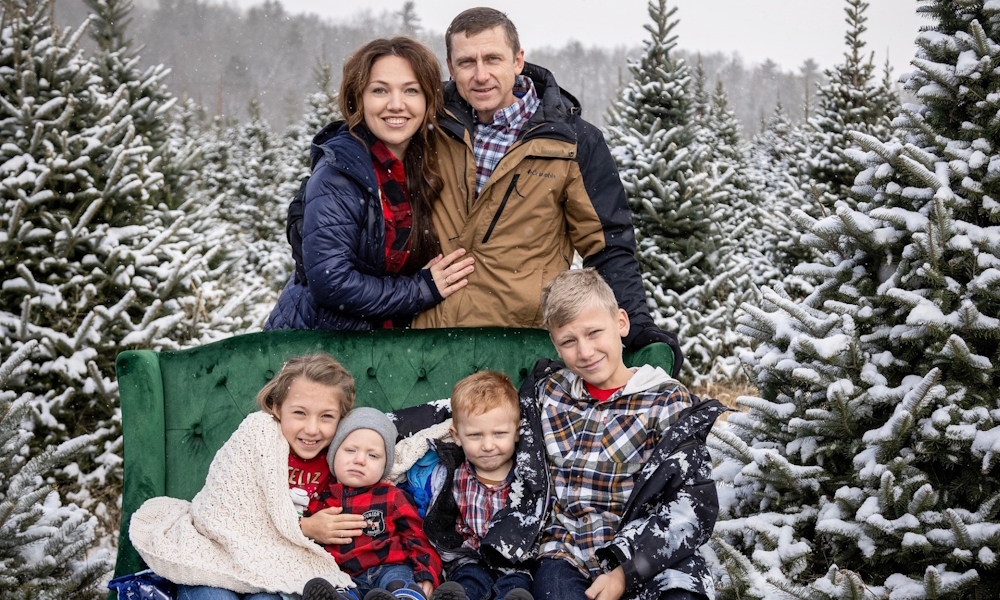
“The kids started crying, especially our daughter,” she said. The couple had three children, including a five-month-old.
On the news, journalists explained how to protect yourself from the strikes: hide in a bathtub and cover yourself with pillows.
“That day was very long,” Oksana recalled. “And that night was terrible.”
They kept their lights off and avoided windows, due to news reports of spy drones. The next morning, they decided they needed to leave “probably for a couple of days, for two weeks maximum.” They packed some important items and documents and headed for the Polish border.
They haven’t been home since.
It took them 72 hours to cross into Poland, a trip that usually takes 45 minutes. The flood of people trying to leave Ukraine came in cars, on buses and on foot.
“We saw some people walking in pajamas, without shoes,” she recalled, noting the cold and snow.
Some had backpacks, others struggled to carry babies bundled in blankets. People from nearby houses would hand out coffee, food and warm clothes.
“It was something that you will never forget.... It was really painful,” Oksana said. “We were blessed that we were in the car. Yes, it was hard, but you could start the engine from time to time so it’s warmer.”
When they finally reached the border, they were amazed at the concern. The Poles ran to their car, asking them what they needed and encouraging them.
“We were so afraid, but we were so happy that we were with good people,” she said.
They stayed in Poland for about two weeks, and then Yuriy’s boss asked them to relocate to Austria for a few months as it became clear the war would not end soon. Their children tried to continue their lessons online, as their school would stream their classes.
“It was very hard,” Oksana said, because with every siren signaling an air strike, everyone in the class had to go to the bomb shelters.
The teacher would call back from the basement, trying to explain the material during airstrikes with variable electricity and Internet signal. It simply wasn’t a long-term solution. Homeschooling is not generally considered an option in the region, and the children needed to take intensive language classes to attend in-person schools, which was a struggle. They spent several months moving between different countries and regions. While the Chornyy family was thankful for, as Oksana put it, “miracle after miracle” of having places to live for short times, they needed stability.
A new chapter
One day, Yuriy was speaking with a friend who lives in the United States. He recommended they try relocating to the U.S., where they already spoke the language and had friends. It would give them the chance to relax after months of being in survival mode. They already had tourist visas from their canceled trip in 2020. Their friend suggested they look into the U.S.’s refugee program.
"One person called us from the USA and said, ‘There is a program called Uniting for Ukraine’, I want to be your sponsor. Are you ready to move to the USA?” Oksana said.
Uniting for Ukraine was created in April 2022, offering a pathway for Ukrainian citizens displaced by the war to live and work in the U.S. on a temporary basis. This initiative required each Ukrainian family to have a sponsor and to meet certain eligibility requirements.
“After one week, we received acceptance and the ‘Uniting for Ukraine’ documents we needed to leave Europe,” Oksana recalled.
Thanks to Yuriy’s job with Austrian Airlines, they were able to book affordable tickets to fly to the U.S. Their friend helped them find a house they shared with another family, and they began a new life.
But because Yuriy’s employer did not have a labor agreement with the U.S., he had to sacrifice his job and now works in construction.
The Chornyy family is grateful their children are in school and participating in Boy Scouts of America, but they miss their family, too, especially during holidays and birthdays.
"It's very painful, because in Ukraine, we were together with family all the time and could visit grandparents,” Oksana said.
The most painful point came about six months after they moved to the U.S., when Okana’s father passed away. She could not attend his funeral because their refugee status would be revoked if they left the U.S. for even a short time.
Yet that is a sacrifice they are willing to make if they can stay.
A bond with Mid-Michigan
One of the many ways God’s goodness is evident is through the support they’ve received from others, including St. Brigid of Kildare Catholic School in Midland, where LeAnne Osborn teaches. (LeAnne is the wife of Dr. Dan Osborn, who worked with Yuriy in the ‘90s.)
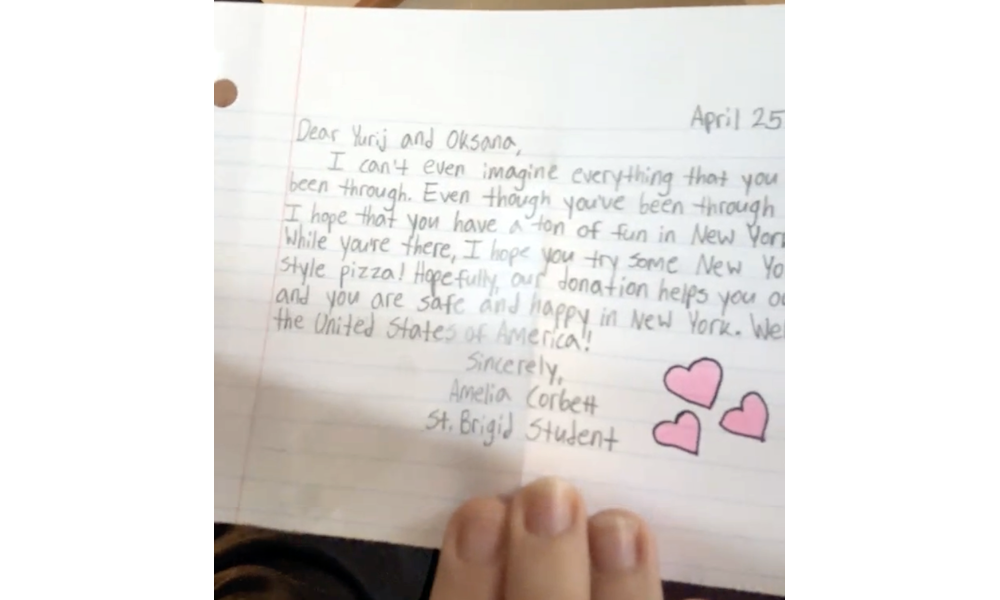
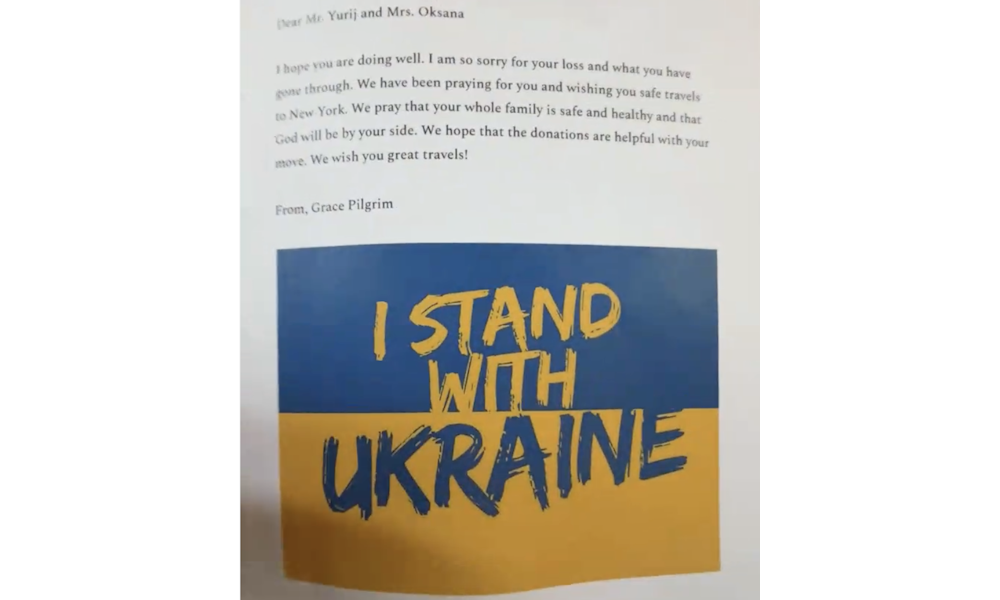
The Chornyy family has a stack of cards made by St. Brigid students, which was given to them along with a donation to help them start their new life in the United States.
“We will save all of that forever. It’s our memory,” Oksana said.
On a video call, Oksana and Yuriy read some of the cards.
“Dearest Yuriy and Oksana, you have all my sympathy because of this war. We hope our donations will help you in New York. We hope for peace in your home country. You will be in our prayers, and we will stand with Ukraine. Let God be among us and help you through your hard times of need. Sincerely, Ian.”
“Dear Yuriy and Oksana, it's hard to understand what you're going through right now, but you have gotten this far. I hope you enjoy living in the United States, and I hope our donation helps you stay strong. Loving thoughts and prayers, Izzy.”
Many cards have the American and Ukrainian flags; the Chornyy family were excited to see the students learned the colors of their flag.
“It was a really big, really pleasant surprise,” Yuriy said. He recalled it being especially hard in the beginning, when they had very little. “Donations like that just really helped us.”
They were able to visit Midland and the Osborns a few years ago, and the two families get together annually. Yuriy’s mother was able to visit on a tourist visa when their youngest child was born.
They have a few items from home, too. A Ukrainian flag, traditionally embroidered garments and a table runner, some photos and religious icons — including one that was a gift to their toddler from his godfather, who is fighting on the front lines. They miss big family gatherings and traditions, especially around the holidays.
As Christmas neared, the Chornyy family was keeping busy with work, school and kids’ activities, but the uncertainty of their temporary protection status (TPS) was never far from their mind.
“We’re asking for prayers. We really need stability — and it’s not about us adults, but about our kids,” Oksana said, adding in the same breath, “Thanks be to God, we have the same work, the same schools, the same house we are renting. We are healthy and have food.”
Holding firmly to the faith that has seen her family through so much, Oksana simply asks for prayers, following Jesus’ command in Matthew 5:44: “But I say to you, love your enemies, and pray for those who persecute you.”
"Pray for our situation with the papers ... pray for our soldiers, for our people there and for Russia.... As our Blessed Mother said, we have to pray for Russia, for their conversion.”
During the Virgin Mary’s 1917 apparitions in Fatima, she requested that Russia be consecrated to her Immaculate Heart. Bishop Robert Gruss joined with Pope Francis and bishops around the world in consecrating Russia and Ukraine to the Immaculate Heart of Mary on March 25, 2022.
"Yuriy and Oksana come from the western part of Ukraine, where the Ukrainian Greek Catholic Church (fully united with the Pope) suffered much persecution in the Soviet era,” explained Dan Osborn. “As a lay missionary there in the early 1990s, I learned how priests of this underground Church had to celebrate the liturgy in forests and how millions of Ukrainians were put to death under Stalin.”
“Ukraine has been and remains a land of martyrs and of heroic Christians who preserve their faith even in the midst of fierce persecution,” he said. “Yuriy and Oksana continue this powerful witness of the Ukrainian people."
Yuriy is quick to point out they like living in the U.S. and are careful to follow the law and ensure they are going about the immigration process properly.
“Because we don’t know what will happen, it’s kind of hard to plan. We had our plans, and we had our dreams and —”
Oksana interjected. “You’re really afraid to have dreams, because in one moment, policemen can come and say, ‘O.K., you need to move from here.’”
"We love this country, but for us, it's very hard all the time to be without any stability,” Yuriy said.
The family’s current immigration papers expire in June. The Chornyy family applied for a TPS extension, but their status — or when they will learn more — remains unclear.
"Oh, man, it's so complicated. And we had the baby here,” Oksana said. “I cried for probably two months because we didn't have a house, we didn't have a car — nothing — and God sent me another baby.... But now, we have a house to rent, we have transportation and the kids are happy. So, with the baby, God blessed us more. But ... our baby is American. We are Ukrainians with TPS. Our baby can stay here, but maybe we cannot.”
“Still,” she added, “God is very good.”