From AI to immigration, bishops’ assembly includes dialogue and decision-making
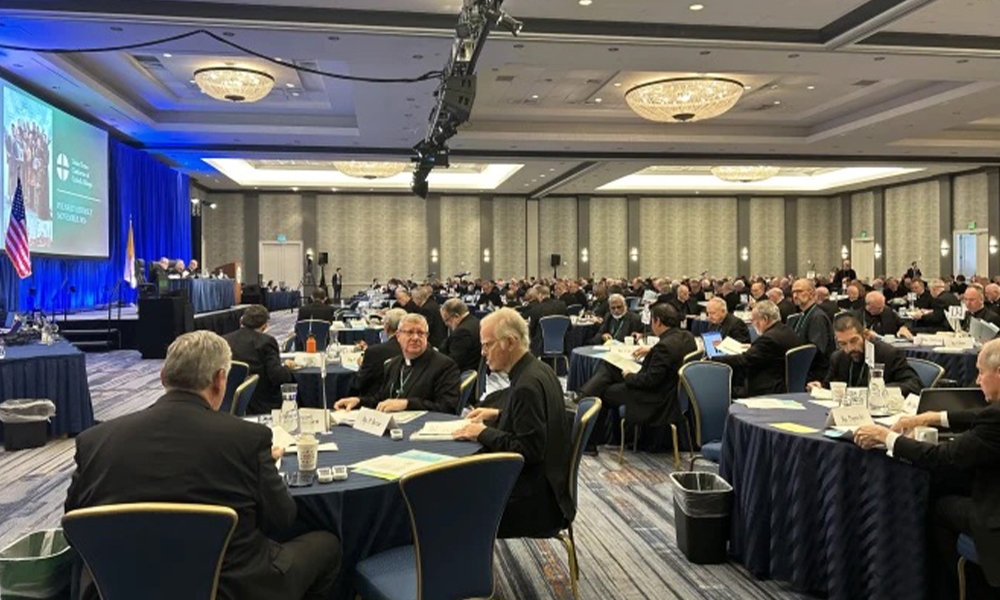
Every November and June, the bishops of the United States gather for a few days for prayer, fraternal dialogue and meetings. Allow me to share some of the highlights of the recent Fall Plenary Assembly in Baltimore that took place from Nov. 10 through 13.
Every November and June, the bishops of the United States gather for a few days for prayer, fraternal dialogue and meetings. Allow me to share some of the highlights of the recent Fall Plenary Assembly in Baltimore that took place from Nov. 10 through 13.
The first day of our gathering always begins with a morning of prayer and retreat — communal prayer, Eucharistic Adoration, a reflection given by one of the bishops and the opportunity for the Sacrament of Penance. This allows us to begin our meeting focused on what is most important: Jesus Christ. We concluded the morning with Mass celebrated at the Basilica of the Assumption, America’s first cathedral, constructed between 1806 and 1821, soon after the founding of our country.
At the beginning of the public session on the second day, the body of bishops approved a message to the Holy Father, assuring him of our prayers and communion, while also acknowledging our mutual concern surrounding the challenges the Church faces in the United States and around the world. The president of the USCCB also gave an address to the bishops. Archbishop Timothy P. Broglio, as the outgoing president, spoke of the task of us bishops is to “proclaim the truth in and out of season, to reaffirm the dignity of the human person and find ways to make the Gospel resound in the hearts of believers and beyond, knowing that it is not easy and it will not become easier. We were challenged “to keep the goal of an encounter with Jesus Christ uppermost in our minds and in those of the people we are privileged to serve.” This address can be found on YouTube by searching “November 2025 Plenary Assembly — Archbishop Broglio Presidential Address.”
Following Archbishop Broglio’s address, Cardinal Christophe Pierre, the papal nuncio to the United States, offered his own remarks. He began focusing on two questions for discernment in the Church’s life today: “Where have we been?” and “Where are we going?” This is an essential part of Christian discernment and is something that, as bishops, we must all do as shepherds of the Catholic Church in the United States today. The guiding light is the teaching and vision of the Second Vatican Council. It is the “key to understanding what kind of Church we are called to be today and the reference point for discerning where we are headed.” This is the direction in which Pope Leo XIV is guiding the Church today as he begins his papacy. This address can be found on YouTube in a video titled “November 2025 Plenary Assembly — Cardinal Christophe Pierre”.
One of the key highlights was the discussion on the topic of immigration and our government’s recent enforcement actions that are causing anxiety and fear in communities across the country. This led to the approval of issuing a special message on immigration, exhorting the government to recognize the fundamental dignity of all persons, including immigrants. This is fundamental in our Catholic Social Teaching. We support “meaningful reform of our nation’s immigration laws and procedures. Human dignity and national security are not in conflict. Both are possible if people of good will work together. We recognize that nations have a responsibility to regulate their borders and establish a just and orderly immigration system for the sake of the common good.”
Every three years a new president and vice-president of the USCCB are elected. Archbishop Paul S. Coakley of Oklahoma City was elected president, and Bishop Daniel E. Flores of Brownsville as vice-president. The body of bishops also elected new chairmen of six standing committees.
One of the recent changes to our meetings was the addition of having periods for fraternal dialogue, bringing the bishops into small groups to discuss various aspects of our ministry and the life of the Church. The bishops have welcomed this because it provides an opportunity for us to get to know each other and to hear what is happening in other dioceses. It is also a way of promoting a synodal approach to the Church through more dialogue and listening sessions.
This takes place during executive sessions that are limited to bishops and are not livestreamed. The fraternal dialogues and other informational sessions included discussions on a variety of topics: the ongoing implementation of the synod; best practices to continue the instruction of Laudato si’; the importance of providing post-abortion healing ministry in our dioceses; and Forming Consciences for Faithful Citizenship (the bishops’ teaching document on the political responsibility of Catholics).
As the Conference of Bishops, we voted in favor of consecrating the United States to the Sacred Heart of Jesus in June 2026, marking the 250th anniversary of the signing of the Declaration of Independence next year.
An updated version of the Ethical and Religious Directives for Catholic Health Care Services, or ERDs, was approved as well. The ERDs — developed in consultation with medical professionals and theologians, and regularly reviewed by the U.S. Conference of Catholic Bishops — articulate ethical standards for health care in light of Church teaching and provide authoritative guidance on moral issues encountered by Catholic health care.
The revisions underscore the role that those involved in the ministry of Catholic health care services have in providing the best medical care, as well as Christ’s compassionate accompaniment to all patients, no matter who they may be or from what condition they may be suffering. Revisions in this new document contain explicit prohibitions against so-called gender-affirming care. These ERDs will be promulgated in every diocese.
Finally, among many other items on the agenda, there was a fascinating presentation given by Dr. Paul Scherz of the University of Notre Dame on understanding artificial intelligence (AI) and the ethical implications of AI, especially in the context of the life of the Church.
As leaders in the Church, our two meetings per year allow us to connect with one another as bishops, listen to one another and support one another. Crucial for the Church’s mission and governance, these meetings provide us a platform to engage in discussions and address diverse topics pertinent to the life of the Church and our culture.
As the bishops of the United States seek to address and respond to the variety of issues and concerns that affect the life of the Church both within the Church community and within contemporary society, I ask that you please pray for an outpouring of the Holy Spirit as we discern the Lord’s will. Come Holy Spirit!
The Most Rev. Robert D. Gruss is the seventh bishop of the Catholic Diocese of Saginaw.