Painless Grace and Painful Grace
Once a month my priest fraternity gathers to have a meal together and to share how life is going. These gatherings are a great gift to me. We encourage each other to share one blessing and one challenge from the past month. I like to think of these as sharing one painless grace and one painful grace. It helps me remember the words of St. Paul, “We know that all things work for good for those who love God, who are called according to his purpose” (Romans 8:28).
Once a month my priest fraternity gathers to have a meal together and to share how life is going. These gatherings are a great gift to me. We encourage each other to share one blessing and one challenge from the past month. I like to think of these as sharing one painless grace and one painful grace. It helps me remember the words of St. Paul, “We know that all things work for good for those who love God, who are called according to his purpose” (Romans 8:28).
Has that ever happened to you? Have you realized Christ calling out to you through some trial? Has he led you to a new place, new treasure, new understanding, and new love through the pain of the cross? In the light of faith, even our experience of the dark moments changes when looked at through the eyes of Christ.
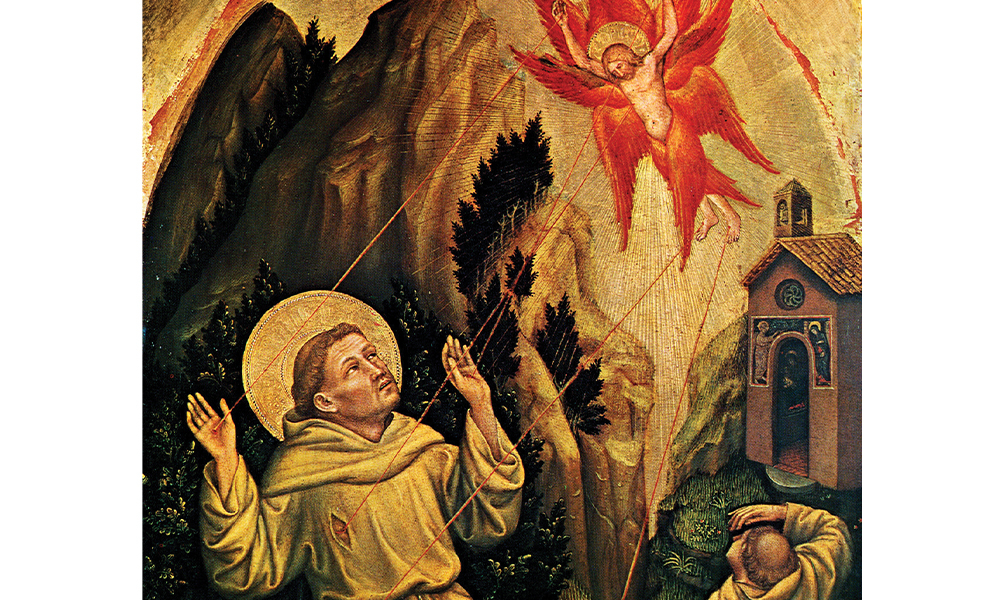
I have been reflecting on different aspects of St. Francis of Assisi’s life in this column during this Year of St. Francis proclaimed by Pope Leo XIV. One of the memorable features of the life of St. Francis was his stigmata. He received the stigmata while praying on Mt. La Verna. He received the wounds of Jesus in his body. So great was his desire to be like Jesus that he was given a share in Jesus’ passion by sharing in his wounds.
The stigmata is a visible reminder that to be conformed to Christ is to share in his passion. Francis received the stigmata, but even before that he was offering his body as a living sacrifice. (Romans 12:1) He was “crucified with Christ,” as St. Paul tells us. (Galatians 2:20)
Jesus spoke to Francis from the cross at San Damiano, “rebuild my church.” Part of how Francis would rebuild it was by participating in Jesus’ own death. Through his wounds he was configured to Christ and united to Christ.
Some wounds are healed by Jesus. Blessed be his name! Let us have faith in his healing power. But Jesus also chooses to transfigure wounds. There are painless graces, and there are painful graces.
In family life, suffering can bring about deeper union with Christ when we go through it with him and in faith. Have you ever drawn closer to a loved one through some trial? Spouses know this. We have a beautiful example of the witness of married love with our cover story on Mandy and Barry Borsenik. What a beautiful example of the love of the cross in a marriage!
Francis wrote his beautiful Canticle of Creatures after he received the stigmata. He also dealt with terrible eyesight. The crusades were a cause of pain. Likewise, the challenges coming from his quickly growing order brought the cross. He and the leaders in the fledgling community wondered how the Gospel could be lived sine glossa (“without explanation”) while balancing the very real concerns of living in the world and having to care for all these people and administrate an order. Much was on his plate.
Francis was in pain, but he saw that even his pain could be a grace. In that beautiful canticle he even praises those who bear infirmity, “Praised be You, my Lord, through those who give pardon for Your love, and bear infirmity and tribulation. Blessed are those who endure in peace for by You, Most High, shall they be crowned.”
Our hands may not have the nail marks, but we do love sacrificially through them. Pushing a loved one in a wheel chair, changing a diaper of an infant, faithfully preparing a meal or being diligent at one’s job. There are many ways in which we love sacrificially through our bodies.
Perhaps from time to time, you could talk with your spouse or children and reflect together, “What was a painless grace this past week? What was a painful grace?” Be open to the surprising grace of God. He’ll teach you to sing his praises even in your wounds.
Father Andy Laframboise is rector at the Cathedral of Mary of the Assumption and director of priestly vocations. He holds a licentiate in Sacred Theology in Marriage and Family Studies from the Pontifical John Paul II Institute for Studies on Marriage and Family