
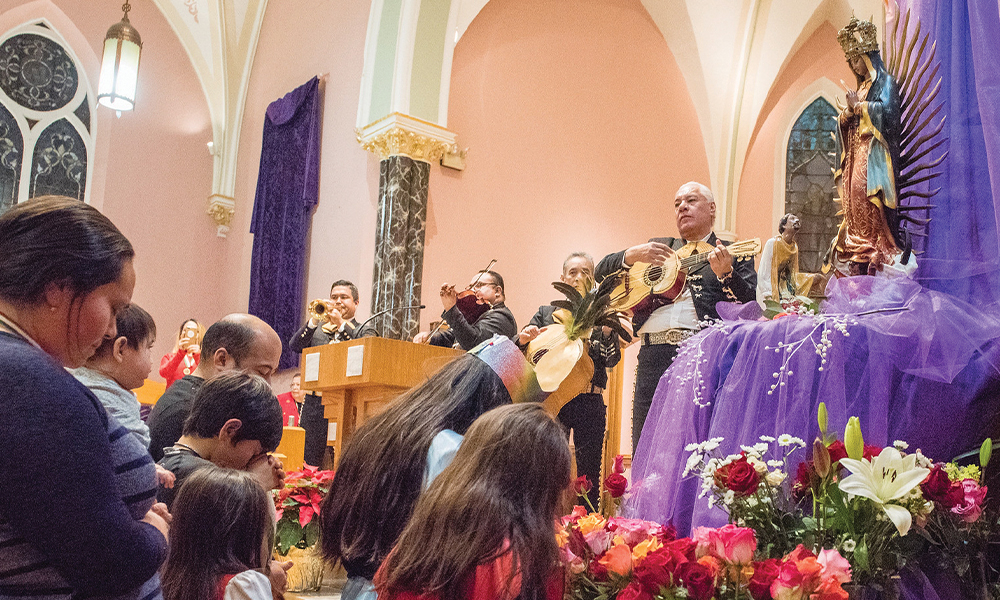
Novenas to Our Lady of Guadalupe in the Saginaw Valley
In the 1920s, many Hispanic/Latino families started to come from Texas, the Southwest and Mexico to the Midwest. Many arrived in Michigan, including Saginaw and the Tri-Cities area. These families came seeking a better way of life, employment and opportunities for the future of their children. The men worked in the railroads, on farms, in automobile factories, and in the foundries wherever they could find work.
In the 1920s, many Hispanic/Latino families started to come from Texas, the Southwest and Mexico to the Midwest. Many arrived in Michigan, including Saginaw and the Tri-Cities area. These families came seeking a better way of life, employment and opportunities for the future of their children. The men worked in the railroads, on farms, in automobile factories, and in the foundries wherever they could find work.
Along with their dreams, they brought their customs, traditions, their Roman Catholic Faith, and with that, a strong devotion to Our Lady of Guadalupe, the Patroness of Mexico and Patroness of all the Americas. It was not unusual to find images of Our Lady of Guadalupe in their homes and their vehicles. Praying the rosary was part of their Catholic faith.
Here in North America, including Mexico, Canada and the United States of America, our Marian devotion is often centered around our Blessed Mother as she appeared in December of 1531 to the American Saint Juan Diego at Tepeyac Hill in what is modern-day Mexico City. She became known as Our Lady of Guadalupe and appeared four times to Saint Juan Diego and once to his dying elderly uncle, Juan Bernardino. The fourth appearance to Saint Juan Diego was the most wonderful as she revealed her image on his “tilma”. It is this miraculous image that we can see even today, four hundred and ninety-five years later. In just a few years, in 2031, we will celebrate the 500th anniversary of these miraculous apparitions.
The Latino families that first came here, celebrated their devotion to our Lady of Guadalupe with annual novenas (nine days of prayer) on the anniversary of the dates of our Blessed Mother’s apparitions, beginning on each Dec. 4 and ending on Dec. 12, the Feast Day of Our Lady of Guadalupe. In 1927, these families first began to hold these novenas in their homes with families taking turns hosting each other. Eventually, they were permitted to hold the novenas in the Parish of St. Joseph of Saginaw. This year will be the 99th year that Novenas to Our Lady of Guadalupe have been celebrated in the Saginaw area. Next year, 2027, the Parish of St. Joseph Saginaw will be celebrating the 100th anniversary of these Novenas.
Eventually other parishes, in what eventually became the current Diocese of Saginaw’s eleven counties, started hosting novenas to Our Lady of Guadalupe. There came a time that the Latino community asked for a chapel to Our Lady and in November of 1971, Bishop Francis F. Reh dedicated the Guadalupe Chapel and Center in Bay City, Michigan with 74 families.
Today, the Diocese of Saginaw continues to honor our Blessed Mother under the title of Our Lady of Guadalupe, Patroness of the Americas and Secondary Patroness of the Diocese of Saginaw. The primary patroness is Mary of the Assumption. In December of 2025, several parishes again held special celebrations in honor of Our Lady of Guadalupe, including but not limited to, several in Saginaw, Bay City, and Midland counties and in the Thumb part of Michigan. The Office of Multicultural Ministry has collected the information from parishes again this year and will be publishing a full list of 2026 Guadalupe events. Go to saginaw.org for more information or call the office at 989-797-6604.
Guadalupan Jubilee Year
Pope Leo XIV granted a Guadalupan Jubilee year to mark the 50th anniversary of the dedication of the current Basilica of Our Lady of Guadalupe in Mexico City and the transfer of the image of the Virgin to this newer shrine. That transfer and dedication was celebrated on Oct. 12, 1976. The current Guadalupan Jubilee year began on Oct. 12, 2026, and ends on Oct. 12, 2027.
In a statement published by the archdiocese on Sept. 9, Cardinal Carlos Aguiar Retes of Mexico City explained that a plenary indulgence will be granted to the faithful who visit “with devotion and a contrite spirit the sacred house of St. Mary of Guadalupe and participate in a liturgical act or spend time in prayer at the basilica.” To receive it, they must also fulfill the usual conditions established by the Church: sacramental confession, Eucharistic Communion, recitation of the Creed, and prayer for the intentions of the Holy Father.
This Guadalupan Jubilee corresponds to the fifth year of the nine-year novena leading up to the jubilee marking the 500th anniversary of Our Lady’s apparitions to St. Juan Diego. The novena began in Mexico four years ago. Since then, the bishops of that country with the bishops of the United States and Canada have joined together in their initiative for the next five years.
Bishop Oscar Cantú, Bishop of San Jose in California and chairman of the USCCB’s Subcommittee on Hispanic/Latino Affairs, presented a broad proposal for activities for participating in these years of jubilee preparation. One proposal is that each diocese “be offered an exact replica of the tilma of Our Lady of Guadalupe, printed on similar cloth and touched to the original, making it a third-class relic.”
These tilma relics can then be enthroned in each Diocese as the Church prepares for the 500th anniversary of the Guadalupe Marian apparitions in 2031.
The proposal is set out in “One Tilma, One Heart: Walking with Our Lady of Guadalupe in the Footsteps of Saint Juan Diego” and is part of the Intercontinental Guadalupe Novena’s 2025–2028 strategic plan, which aims at “a profound spiritual renewal and unity under the protection of Our Lady of Guadalupe.”
Under the plan, the enthronement of each tilma in every diocese is to be followed by two years of missionary activity including pilgrimages, service, and catechesis. The Diocese of Saginaw is beginning this process. Our Lady of Guadalupe, Pray for us!