350 Years of Hope
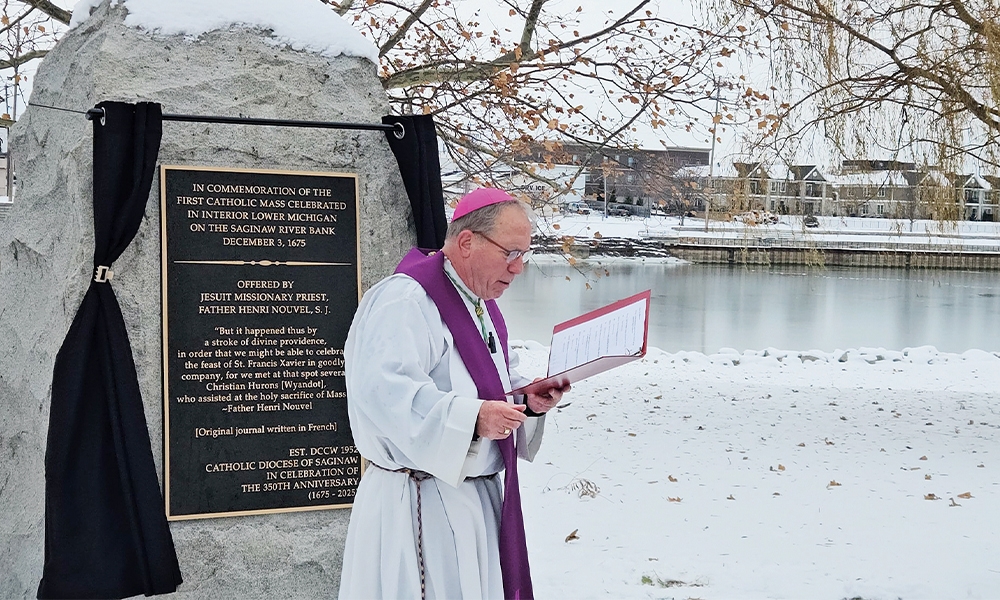
Dec. 3, 1675, may not be a date in most history textbooks, but for Catholic Michiganders, it is a milestone. This is the day that we remember the first Mass celebrated in the interior of the lower peninsula of Michigan— and it happened right here in what is now the Diocese of Saginaw!
Dec. 3, 1675, may not be a date in most history textbooks, but for Catholic Michiganders, it is a milestone. This is the day that we remember the first Mass celebrated in the interior of the lower peninsula of Michigan— and it happened right here in what is now the Diocese of Saginaw!
This historic Mass was celebrated by a Jesuit missionary, Father Henri Nouvel, S.J. While the exact date of his birth is unknown, Father Nouvel was born sometime in the early 1620s in Pézenas, France, a short distance from the Mediterranean Sea. Father Nouvel was already a priest when he joined the Society of Jesus (the Jesuits) in August 1648. Father Nouvel sailed to New France in 1662, where he established his first mission in what’s now the Rimouski (Quebec, Canada) area at the end of 1663. In 1671, Father Nouvel was sent to Jesuit missions in the Great Lakes region amongst the Odawa people and, after being stationed at the St. Ignace Mission, was made “Superior of the Ottawa Missions” in 1672.
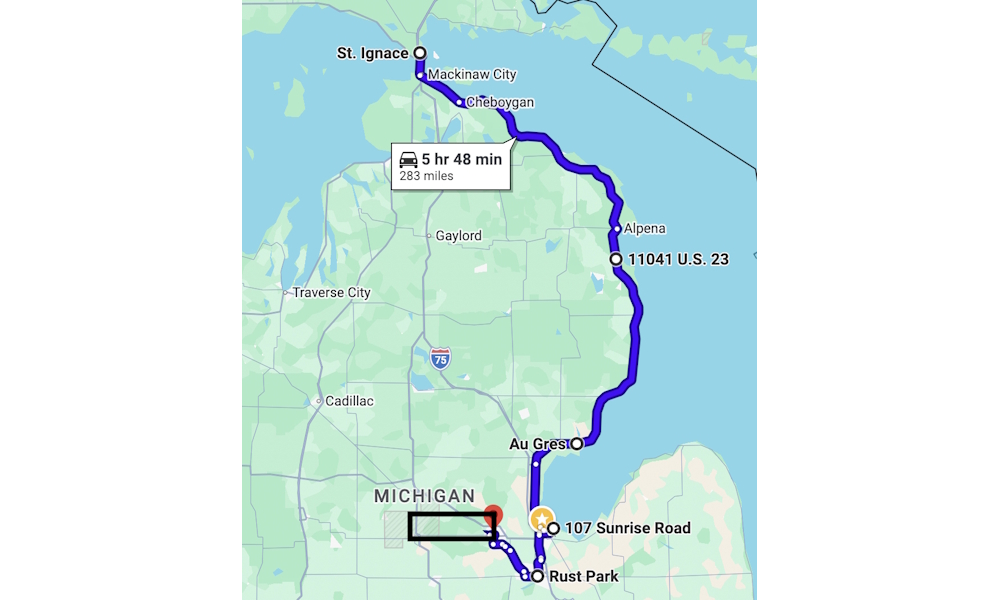
During this time, Father Nouvel made several mission trips across the Great Lakes, including one connected with the Saginaw region. In November 1675, while stationed at St. Ignace, Father Nouvel was visited by a party of Chippewa, who requested a missionary for company on a winter hunt towards Lake Erie. Father Nouvel departed with two Frenchmen on Nov. 8 and travelled 10 days along the northeastern shore of Michigan’s Lower Peninsula, where he eventually met several converts to Christianity on the southern side of what is now Thunder Bay.
On the 12th day, the party arrived in a marshy area which, combined with bad weather, made camp quite difficult to manage. The missionaries retreated to a nearby cove near the mouth of what is now known as the Au Gres River. The following morning, dense fog, rain and thunder held them at this site all day, and was immediately followed by a “chilled wind that froze the whole bay over.”1 After several days of prayer to the Holy Immaculate Virgin, and through the mediation of St. Ignatius and St. Francis Xavier, the party was inspired to carry their canoes and baggage to a nearby island, where they were able to break ice and continue their journey.
On Dec. 1, the party was finally able to retreat from Lake Huron by entering what is now the Saginaw Bay and advancing on what is now known as the Saginaw River (it was referred to as a “fine river”). With winter fast approaching, Father Nouvel and company pushed themselves further up the river, initially missing their intended route at a branch, likely the Tittabawassee River, forcing them to retrace their steps. The party found a campsite and celebrated Mass on the feast of St. Francis Xavier on Dec. 3, 1675, after weeks of weathering storms, battling currents and facing the unknown. A sizable group of Christian Hurons joined them and assisted in the celebration of this first Mass in the interior of Michigan’s Lower Peninsula, on the banks of what is now known as Saginaw.
The remainder of Father Nouvel’s travels seemed rather smooth, compared to the journey along the coast of Lake Huron. The following day, the intended campsite that he was seeking was found abandoned, and the party continued onto the Tittabawassee River, followed by the branching Chippewa River in what is now Midland. On Dec. 7, the party arrived at their winteringplace, on the Vigil of the Immaculate Conception of the Blessed Virgin. After their cabin and the chapel were set up, Father Nouvel went into all the cabins to prepare for the next day's feast. Father Nouvel wrote of this overwhelming emotion: “I cannot explain the consolation that I felt, on the following day, in celebrating our adorable mysteries in our Chapel in so remote a spot in the midst of these great forests, and in administering the sacraments therein to those who were worthy of them.”2
There, somewhere between modern-day Midland and Mount Pleasant, Christmas was celebrated with local converts. “We made a small Cradle beside our altar, to which our Christians came at midnight; and during the day they made the forest resound with their Hymns in honor of the new-born Jesus.” [sic]3 On Dec. 29, Father Nouvel traveled to the Nipissing people to pray and instruct, followed by a second excursion in January to make a pastoral visit to members of the Misissaki nation, which included the baptisms of three newborns. Father Nouvel continued his mission work teaching, preparing catechumens for the sacraments and baptizing children and adults until mid-March of 1676.
In 1677, Father Nouvel traveled to the St. Ignace Mission to attend the funeral of Father Jacques Marquette, who is considered a great explorer of North America, including the Michigan/Great Lakes region. Though Father Marquette died in 1675 near what is now Ludington, his bones were then buried at the St. Ignace Mission.
Father Nouvel continued his mission work throughout the Great Lakes region up until his death at the St. Francis Xavier Mission near what is now Green Bay, Wisconsin. Evidence suggests one of two dates for his death, either late 1701 or October 1702. Father Nouvel’s legacy continues, especially throughout the Great Lakes region. And it is in honor of his ministry and mission work that we celebrate 350 years of Catholicism here in the Diocese of Saginaw.
Citations:
- Thwaites, Reuben, ed. The Jesuit Relations and Allied Documents: Travels and Explorations of the Jesuit Missionaries in New France, 1610-1791, 60:217. Cleveland, Ohio: Burrows, 1901.
- ibid, 221-223
- ibid, 230